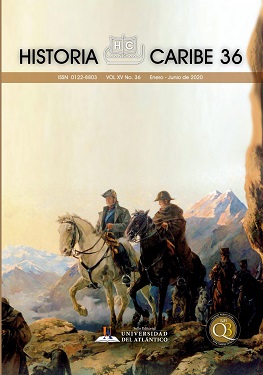
Army and the definition of its constitutional principles. Obedience and non- political deliberation in Chile, 1829-1830
DOI:
https://doi.org/10.15648/hc.36.2020.10Keywords:
Army, militarism, military obedience, political deliberation.Abstract
This article deals with the Chilean Army principles of obedience and non-military deliberation during the 1829 civil war, when two interpretations of these principles were confronted: some soldiers supported the government meanwhile others rebelled against it, arguing that the authorities had violated the constitution.
The study concludes that, although there was unity around these principles in theoretical terms, the practical understanding of them was contradictory, which was decisive for the outbreak of war and for the creation of a new constitutional order in Chile.
Author Biography
Alejandro San Francisco Reyes, Universidad San Sebastian (Chile)
Profesor del Instituto de Historia y de la Facultad de Derecho de la Pontificia Universidad Católica de Chile (Chile), investigador del Instituto de Historia de la Universidad San Sebastián (Chile). Correo electrónico: asanfran@gmail.com El autor es doctor en Historia por la Universidad de Oxford (Inglaterra). Entre sus publicaciones recientes está la obra de la cual es Director general: Historia de Chile 1960-2010. Tomo 5 y 6. Las vías chilenas al socialismo. El gobierno de Salvador Allende (Santiago, Universidad San Sebastián/CEUSS, 2019). Entre sus temas de interés se encuentran Historia política de Chile, Historia militar, Historia de los conceptos.
How to Cite
Downloads
Downloads
Published
Issue
Section
License
Copyright (c) 2020 Historia Caribe Journal

This work is licensed under a Creative Commons Attribution-NonCommercial 4.0 International License.
© Universidad del Atlántico. Los originales publicados en las ediciones impresa y electrónica de Historia Caribe, ISSN 0122-8803 e-ISSN 2322-6889, son propiedad de la Universidad del Atlántico, siendo necesario citar la procedencia en cualquier reproducción parcial o total.
Salvo indicación contraria, todos los contenidos de la edición electrónica se distribuyen bajo una licencia de uso y distribución “Creative Commons Reconocimiento-No Comercial 4.0 Internacional” (CC-by-nc). Puede consultarse en https://creativecommons.org/licenses/by-nc/4.0/